


How Do You Choose Between A Traditional Slitter And An Automatic Turret Rewinder?
In the fast-paced world of flexible packaging and label converting, procurement managers often find themselves at a financial crossroads. On one side, the lower initial price tag of a traditional Slitting Machine is tempting for balancing the annual budget. On the other, the undeniable output velocity of an Industrial turret rewinder for labels and film promises a level of throughput that can fundamentally change a workshop's profitability. The real struggle isn't just about the machine itself; it is about accurately predicting which investment will scale with your current order volume without leaving you with a bottlenecked floor just six months down the road.
Understanding The Impact Of Downtime On Your Bottom Line
The fundamental difference between these two technologies lies in how they handle the "changeover" phase. A traditional slitter requires a complete machine halt every time a set of rolls is finished. The operator must manually cut the web, unload the finished rolls, prepare new cores, and re-tape the material. While this might only take five to ten minutes per cycle, those minutes add up to hours of lost productivity over a week of double shifts. For a growing business, this hidden downtime is a silent profit killer that traditional machinery simply cannot overcome.
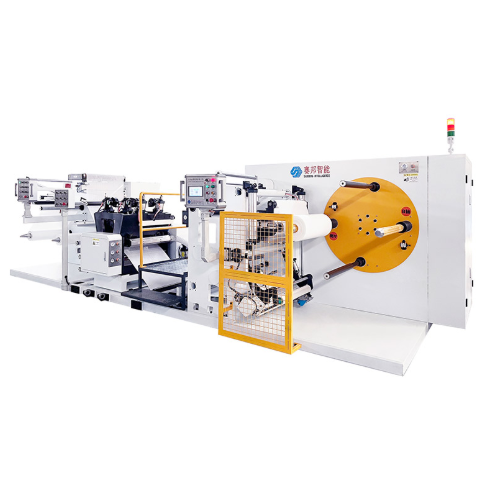
By contrast, an Industrial turret rewinder for labels and film utilizes a rotating turret mechanism that allows the operator—or the machine's automated system—to prepare new cores on one shaft while the other is still actively winding. This "non-stop" operation means the web never stops moving. When looking at long-term efficiency, the ability to maintain a constant speed significantly reduces the wear on motors caused by frequent starts and stops. Our workshop focus has always been on optimizing these transition moments, ensuring that the transition between shafts is seamless and tension-controlled to avoid any material waste.
Evaluating The ROI Of Automation For Diverse Order Volumes
Choosing the right equipment requires an honest assessment of your typical run lengths. If your business specializes in short-run, highly customized boutique labels, a standard slitter might suffice. However, as soon as you transition into high-volume industrial contracts, the labor cost per roll on a manual machine begins to skyrocket. This is where an Industrial turret rewinder for labels and film shifts from being a luxury to a mechanical necessity. It allows a single operator to manage a much higher output, effectively doubling your capacity without doubling your headcount.
Beyond just speed, we consider the technical precision required for modern substrates. Thin films and complex laminates are sensitive to tension spikes during manual restarts. The automated logic found in an Industrial turret rewinder for labels and film provides a level of consistency that manual handling cannot replicate. This precision is what protects your reputation with downstream clients who expect perfectly wound, edge-straight rolls every time. For brands acting as OEM partners for global labels, this consistency is often the deciding factor in retaining high-value contracts.
Tailoring Machinery To Unique Material Challenges
A significant part of our role as a supplier involves ODM work, where we adapt core technology to fit specific material behaviors. Not all films react the same way under high-speed rewinding; some require specific surface coatings on the rollers, while others need specialized ionization bars to manage static. A rigid, low-cost "standard" machine rarely offers the flexibility to integrate these essential features. We prioritize a collaborative engineering approach, ensuring that the tension curves and cutting angles are tuned specifically for the materials you process most.
When you invest in advanced machinery, you are also buying into a more reliable supply chain. By reducing the manual intervention required in the finishing stage, you eliminate the variable of human error. This stability makes your delivery dates more predictable and your waste piles smaller. Whether you are processing heat-sensitive films or high-tack adhesives, the goal is to keep the material moving. We help our partners analyze their current floor data to determine exactly when the shift from manual to turret technology will yield the fastest return on investment.
Conclusion
Deciding between traditional and turret technology is a strategic move that defines your facility's ceiling for growth. While the upfront cost of an automatic system is higher, the dramatic reduction in labor-per-roll and the elimination of changeover downtime often pay for the difference within the first year of operation. It is about choosing a pace of production that allows you to take on larger, more profitable contracts with confidence.
If you are currently crunching the numbers for a workshop upgrade and feel stuck between these two options, we can provide a detailed throughput comparison based on your specific material types. Our engineering team is available to review your current production logs and offer a clear roadmap on how a transition to automated rewinding could impact your daily yield. Reach out to us today for a technical consultation—we can help you de-risk your procurement and find the exact mechanical fit for your next stage of expansion.