


How SAIBANG Supports Custom Ultrasonic Laminating Machine Solutions?
Ultrasonic laminating has become a preferred bonding technology in hygiene and medical material production because it eliminates excessive glue usage, reduces thermal distortion, and delivers clean, repeatable seam structures.
However, not every ultrasonic Laminating Machine performs the same way in real factory conditions. Nonwoven thickness, fiber composition, machine width, emboss pattern, and line speed all directly influence bonding consistency. This is why many manufacturers eventually realize that a standard configuration is rarely sufficient.
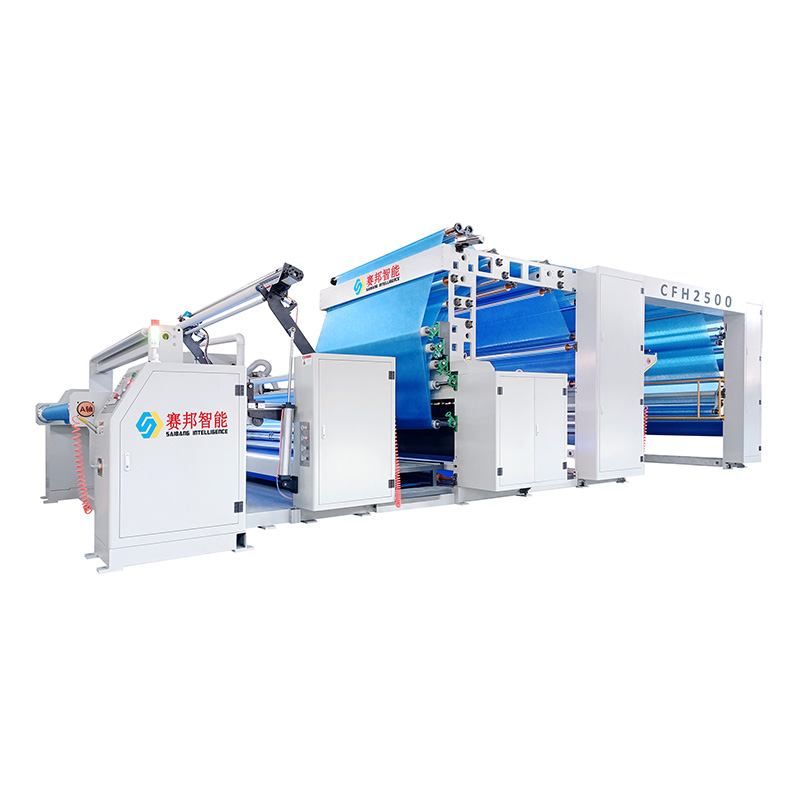
SAIBANG approaches ultrasonic laminating as a project-based engineering solution rather than a fixed product model.
You can explore our full configuration range on the laminating machine page: Ultrasonic Laminating Machine
Why Ultrasonic Laminating Requires Custom Engineering
Ultrasonic bonding works through high-frequency vibration combined with pressure and precise mechanical alignment. The energy transfer must remain consistent across the entire working width.
When machine width increases, structural rigidity and roller balance become more critical. When material changes from standard spunbond to hot air nonwoven, bonding pressure and pattern compatibility must be recalibrated. When output speed increases, web stability becomes the limiting factor.
If these variables are not engineered together, the result is uneven bonding, edge inconsistency, material deformation, or unstable winding tension.
That is why SAIBANG does not treat ultrasonic laminating machines as off-the-shelf equipment. We align machine configuration with real production conditions from the beginning.
Structural Platform Matching Based On Working Width
Machine width determines frame scale, guide system precision, and vibration stability.
SAIBANG supports multiple width platforms including:
650mm compact platforms for focused embossing and specialty applications
1000–1800mm mid-width systems for medical and hygiene materials
1800–2800mm large-width machines for high-output nonwoven programs
Wider platforms require reinforced structure and balanced roller systems to ensure bonding uniformity across the entire span.
Instead of maximizing width blindly, SAIBANG matches platform size to material layout and production goals. This approach protects bonding consistency while avoiding unnecessary structural oversizing.
Speed Stability Over Maximum Speed Claims
In ultrasonic laminating, stable speed matters more than theoretical peak speed.
Typical SAIBANG configurations support:
Design speed up to 80 m/min
Normal stable working speed around 50–60 m/min
Operating inside a controlled speed window ensures bonding strength, pattern clarity, and tension stability remain consistent across shifts.
For customers planning long-term capacity growth, we define a working speed range that allows future expansion without sacrificing quality stability.
This creates a more durable ultrasonic laminating machine setup suitable for continuous industrial production.
Material Adaptation And Emboss Compatibility
Different substrates respond differently to ultrasonic energy. Fiber density, loft structure, and surface texture all influence bonding quality.
SAIBANG adapts configuration to:
Standard nonwoven fabric
Hot air nonwoven
Spunbonded nonwoven
For patterned laminating programs, effective embossing width and finished width alignment are engineered carefully. For example, compact platforms may support effective embossing width around 630mm with finished product width near 600mm, ensuring pattern integrity without edge distortion.
This level of adaptation allows customers to maintain consistent visual appearance and bonding performance across product variations.
Practical Customization Framework
Customization at SAIBANG is structured and measurable. It typically includes:
| Customization Area | Engineering Focus | Production Impact |
|---|---|---|
| Width Platform | Frame rigidity, guide stability | Uniform bonding across full width |
| Roll Handling | Unwind/rewind diameter capacity | Fewer roll changes, smoother tension |
| Speed Planning | Stable working window definition | Reduced defect rate |
| Emboss Matching | Pattern compatibility & energy balance | Consistent surface appearance |
| Control Logic | Parameter management & fault visibility | Faster setup and easier troubleshooting |
This framework ensures customization improves real production outcomes rather than adding unnecessary complexity.
Integration Into Complete Hygiene Production Lines
Ultrasonic laminating machines rarely operate independently. They are typically integrated into larger hygiene converting lines.
SAIBANG designs ultrasonic units with line compatibility in mind, ensuring stable web transfer, synchronized speed coordination, and predictable tension behavior when connected to upstream and downstream modules.
This system-level thinking allows customers to implement a practical ultrasonic laminating machine solution that supports long-term line stability.
Conclusion
Ultrasonic laminating performance depends on width stability, speed control, material compatibility, and structural rigidity working together. A standard configuration may function under limited conditions, but sustained industrial production often requires a customized approach.
SAIBANG supports custom ultrasonic laminating machine solutions by aligning structural design, process parameters, and operational logic with actual production requirements.
If you are evaluating ultrasonic laminating equipment for medical, hygiene, or nonwoven applications, share your material type, working width, target speed, and emboss requirements with our engineering team. We can help you define a configuration that balances performance, reliability, and future scalability.
Previous: