


How Production Planning Supports On-Time Delivery Of Customized Equipment
Customized equipment delivery is won or lost long before final assembly. On-time shipment depends on how clearly the project scope is defined, how accurately parts are scheduled, how tightly production steps are linked, and how early risks are detected. For a project buyer, the real difference is not a single fast process. It is a planning system that keeps design changes, procurement, machining, assembly, and testing moving in the same direction.
At SAIBANG, production planning is built to support customized solutions across multiple application fields, backed by experienced R&D, structured quality control, and full-process service from pre-sales to after-sales.
Planning Starts With A Clear Scope And A Buildable Specification
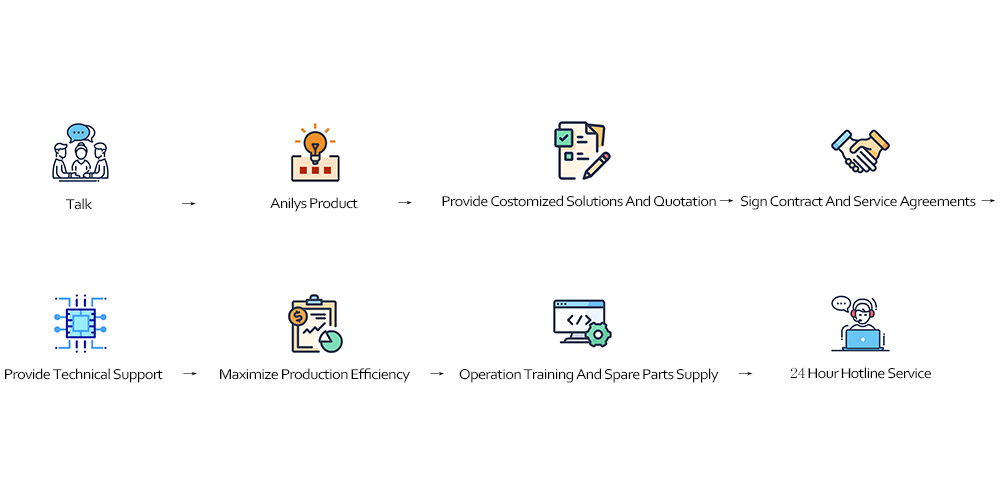
Customization creates more variables than standard equipment. Production planning begins by converting requirements into a buildable specification that includes target output, material behavior, process steps, automation level, safety requirements, and acceptance criteria. This step is connected to a structured communication flow that moves from requirement review to solution and quotation, then to contract and service agreements, and finally to technical support and training.
A buildable specification prevents late rework. It locks the key decisions that affect lead time, such as control architecture, core module selection, and any non-standard interfaces. It also sets the baseline for parts procurement and quality inspection plans.
Modular Structure Makes Scheduling Predictable
Customized lines become easier to plan when the equipment is built on a modular structure. SAIBANG equipment follows a modular logic that connects mechanical structure, transmission system, intelligent control, and process execution modules. This approach supports production planning because modules can be scheduled in parallel rather than waiting for a single long sequential build.
Modularity also supports controlled upgrades. When expansion space is reserved during design, future capacity growth becomes a planned upgrade instead of a disruptive rebuild, which protects both delivery timelines and long-term investment value.
Procurement Planning Protects The Critical Path
Many delivery delays are not caused by assembly speed. They are caused by late components. Production planning identifies the critical path items early and builds a procurement schedule around lead times, inspection time, and installation order.
For key components, SAIBANG emphasizes supplier qualification and incoming inspection discipline, including certification checks and performance verification to prevent nonconforming parts from entering production. Planning also uses staged delivery control, so long-lead items arrive before the workshop reaches the install point, reducing idle time and last-minute substitution risk.
Quality Control Is Built Into The Schedule
A realistic plan includes quality checkpoints, not only final inspection. SAIBANG uses a closed-loop QC logic that covers incoming inspection, in-process inspection, and pre-storage final verification, supported by traceable records and escalation paths for abnormalities.
This matters for customized equipment because custom parts require both drawing conformity and functional compatibility checks. Planning sets time for these checks early, so issues are found while correction is still fast and low-cost, rather than discovered after full assembly.
Workshop Coordination Keeps Workflows Moving
On-time delivery requires coordination between machining, electrical assembly, mechanical assembly, and debugging. SAIBANG describes a workshop flow that follows a clear sequence from materials receiving to parts processing, assembly, commissioning, finished inspection, and shipment.
Production planning supports this flow by:
Assigning each module a target completion window tied to downstream needs
Scheduling tooling, lifting resources, and test stations ahead of time
Locking daily and weekly progress checks so bottlenecks are visible early
Controlling change requests through structured evaluation, so schedule impact is understood before implementation
This coordination is the practical foundation of being a solution provider for customized projects that have fixed shipping windows.
Commissioning And Trial Run Time Is Planned, Not Compressed
For customized equipment, commissioning and trial running are where performance is proven. Planning must reserve sufficient time for parameter tuning, safety validation, and stability testing. Compressing this stage often creates hidden risks that later show up as prolonged on-site ramp-up.
SAIBANG’s service process includes technical support, efficiency improvement, operation training, and spare parts supply as part of full-process delivery. When production planning aligns the factory commissioning baseline with on-site installation needs, the customer receives a clearer starting point and fewer surprises.
Typical Planning Map From Design To Shipment
The table below shows how production planning connects milestones to delivery stability. It is not a fixed calendar, but a practical structure for controlling progress and risk.
| Planning Stage | Primary Output | Delivery Value |
|---|---|---|
| Requirement Freeze | Buildable specification, acceptance criteria | Reduces rework and scope drift |
| Module Scheduling | Parallel build plan for mechanical, control, process modules | Shortens total lead time and improves predictability |
| Procurement Control | Critical path parts plan, incoming inspection readiness | Prevents late-component delays |
| QC Checkpoints | IQC, IPQC, final verification records | Finds issues early and protects stability |
| Assembly And Debugging | Integrated build completion, controlled parameter tuning | Improves first-time pass rate |
| Commissioning Baseline | Stable run validation, training preparation | Speeds site ramp-up and reduces downtime risk |
Conclusion
On-time delivery of customized equipment is not driven by speed alone. It is driven by planning discipline: clear scope, modular scheduling, critical-path procurement control, built-in QC checkpoints, coordinated workshop execution, and protected commissioning time. When these elements are managed as one system, customization becomes predictable and delivery becomes dependable.
Learn more about SAIBANG and our capabilities on the SAIBANG. Share your application, target capacity, and preferred delivery window with our team. SAIBANG can provide planning guidance, configuration recommendations, and practical project support to help move your customized equipment from specification to shipment with confidence.