


Why Process-Level Customization Matters In Liquid Absorption Core Manufacturing
In liquid absorption core manufacturing, final product performance is determined long before converting, folding, or packaging. Absorbency efficiency, leakage control, core integrity, and thickness stability are all direct results of how the core is formed, stabilized, and controlled during production. When manufacturers rely on fixed process structures or generic machine configurations, they often compensate for instability by increasing SAP dosage, core weight, or material cost. Process-level customization addresses this problem at its root by aligning manufacturing logic with product performance targets.
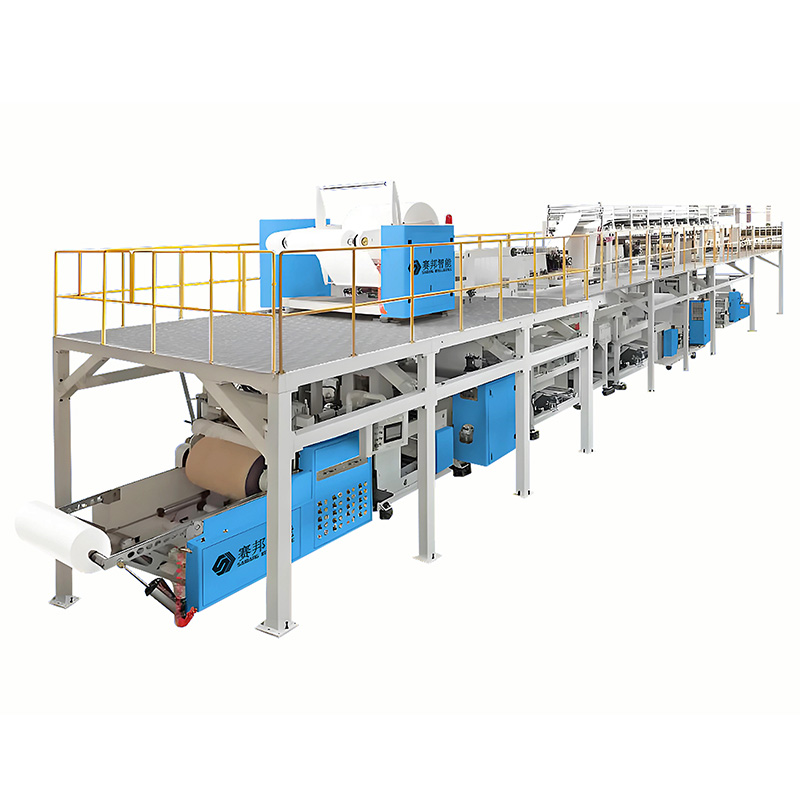
At SAIBANG, we consider process-level customization a production necessity rather than an optional upgrade. By tailoring forming, dosing, stabilization, and control systems to the target core architecture, manufacturers gain predictable quality, lower material waste, and long-term scalability. Our approach is reflected across our diaper making machine systems, which are designed to adapt to different core strategies rather than forcing a single structure onto every product.
What Process-Level Customization Means In Core Manufacturing
Process-level customization refers to adjusting how the core is manufactured, not only what materials are used. While raw materials define the potential performance range, the manufacturing process determines whether that potential is realized consistently at scale.
Key aspects controlled at the process level include:
How fluff pulp fibers are opened, transported, and deposited
How SAP is dosed, distributed, and immobilized within the core
How the core is shaped, stabilized, and compacted before integration
How web tension, alignment, and registration are maintained across stations
Without process customization, these variables are fixed by default machine logic. As a result, manufacturers face unstable basis weight, uneven SAP concentration, weak core integrity, and sensitivity to speed changes or material batch variation. Customization enables each station to respond to the specific core design rather than operating as a generic module.
Core Performance Is Defined By Manufacturing Logic, Not Materials Alone
Two absorption cores using identical pulp and SAP can perform very differently depending on how they are formed. This difference becomes more pronounced at higher line speeds and under real-use dynamic loading conditions.
Manufacturing logic influences:
Liquid intake speed through fiber openness and SAP exposure
Retention under pressure through SAP immobilization and bonding
Structural integrity during bending, compression, and repeated motion
Thickness recovery after packaging and transport compression
If SAP is evenly dispersed without placement logic, intake may be slow and leakage risk increases at the edges. If compression is excessive, rewet increases even when total SAP content is high. If embossing or bonding is not matched to core density, cracking and SAP migration occur during use. These outcomes are not material failures but process design mismatches.
Process-level customization allows manufacturers to shape the internal structure of the core so that absorbency, integrity, and comfort are achieved simultaneously rather than through material overuse.
Critical Core Variables That Require Station-Level Control
Liquid absorption cores are sensitive to a small number of variables that must be actively controlled throughout production. These variables cannot be fully stabilized by end-of-line correction.
The most critical variables include:
Core basis weight uniformity across machine direction and cross direction
SAP-to-fluff ratio stability under speed fluctuation
SAP placement concentration in target zones
Core thickness and density profile after compression
Mechanical integrity under flexing and load
Each variable corresponds to a specific set of process stations. Feeding systems control mass stability. Forming structures control distribution. Dosing systems control SAP accuracy. Embossing and compression stations control integrity and thickness. Web handling systems maintain alignment and prevent deformation. When these stations operate independently without customization logic, adjustments in one area often destabilize another.
Core variable control overview
| Core Requirement | Required Process Control | Result Without Customization |
|---|---|---|
| Uniform absorbency | Stable forming and feeding | Local flooding or dry zones |
| Fast intake | Controlled fiber openness | Surface pooling |
| High retention | SAP immobilization logic | Rewet under pressure |
| Structural integrity | Matched emboss and bonding | Core cracking or migration |
| Low scrap rate | Coordinated web handling | Frequent stops and rejects |
How Customization Reduces Cost While Improving Stability
Process-level customization is often misunderstood as an added cost. In reality, it is one of the most effective ways to reduce total production cost per diaper.
When SAP placement is controlled, manufacturers avoid overdosing to compensate for uneven performance. When compression is tuned to the core structure, less wrap material is needed to maintain integrity. When forming stability is improved, dust generation and machine contamination decrease. These improvements directly reduce scrap, downtime, and cleaning cycles.
Customization also shortens commissioning and troubleshooting cycles. Instead of adjusting downstream stations to mask upstream instability, engineers can tune the exact station responsible for the deviation. This improves overall equipment effectiveness and makes production more predictable across shifts, operators, and material batches. For manufacturers operating in OEM or ODM environments, this stability is essential for meeting customer specifications consistently.
Market-Driven Core Designs Require Flexible Manufacturing Logic
Absorption core requirements vary significantly by market and product positioning. Economy products prioritize cost efficiency and high-speed stability. Premium products prioritize thinness, fast intake, and high retention. Overnight products prioritize capacity under sustained load. Each strategy demands a different balance of basis weight, SAP placement, and compression behavior.
Process-level customization allows a single production line to support multiple core architectures without mechanical redesign. Adjustments can be made through station configuration, control parameters, and forming logic rather than replacing equipment. This flexibility supports faster SKU development, smoother product upgrades, and better alignment between marketing claims and actual product performance.
How SAIBANG Supports Process-Level Customization
SAIBANG designs diaper making systems with customization built into the process architecture. Instead of fixed core logic, we provide adjustable forming, dosing, stabilization, and handling systems that align with customer-defined performance targets. Our engineering approach focuses on coordination between stations so that changes in one zone do not introduce instability elsewhere.
We support customers during line configuration, commissioning, and ramp-up with structured parameter validation and process mapping. This ensures the line reaches stable production faster and remains adaptable as product requirements evolve. For manufacturers planning new capacity or upgrading existing lines, this approach reduces long-term risk while protecting capital investment.
For system configurations and reference models, see our diaper making machine solutions.
Conclusion
Process-level customization matters in liquid absorption core manufacturing because it controls the structural and functional variables that determine real product performance. By aligning forming, SAP dosing, placement logic, embossing, compression, and web handling as a unified system, manufacturers achieve consistent absorbency, strong core integrity, lower scrap rates, and material efficiency at scale. This approach replaces trial-and-error compensation with predictable engineering control.
If you are developing a new absorption core, upgrading an existing diaper line, or aiming to reduce material cost without sacrificing performance, you can consult SAIBANG for technical guidance. Share your target core specifications, SAP strategy, product positioning, and planned line speed, and we will help you evaluate a suitable process configuration and provide support for your production goals.