


Installation And Technical Support for Absorbent Material Production Equipment
Fast commissioning and stable long-term output are rarely the result of equipment alone. For absorbent material production equipment used in hygiene manufacturing, installation accuracy, parameter tuning, operator capability, and after-sales response speed directly affect scrap rate, line uptime, and finished core consistency. SAIBANG builds its support system around one goal: help your line reach qualified production quickly, then keep it running predictably as materials, SKUs, and capacity targets evolve.
If you want to understand our equipment range and support scope in more detail, you can view our diaper making machine solutions.
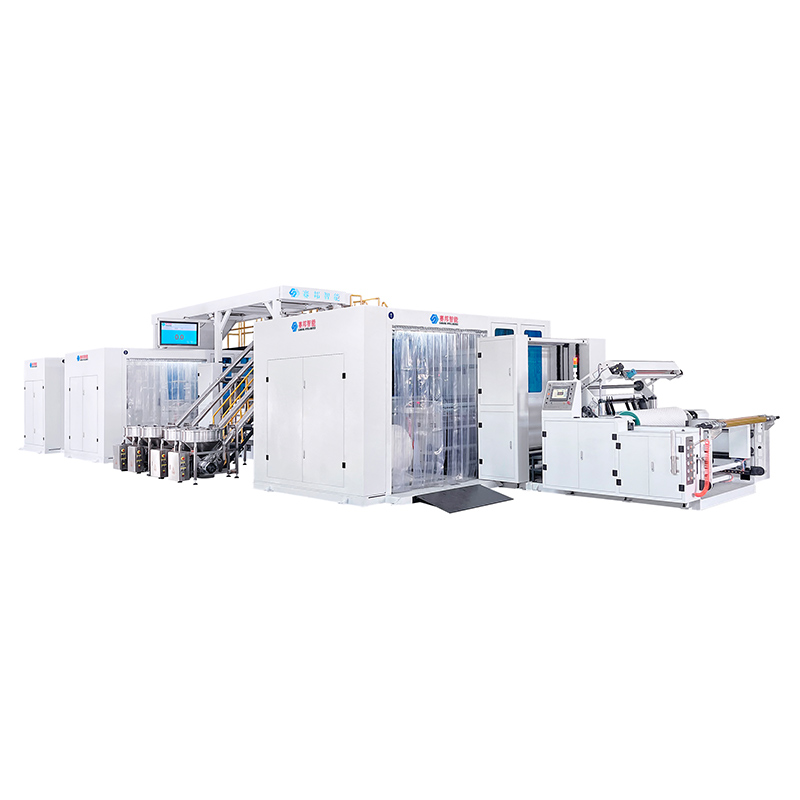
1. What Good Installation Supports
In absorbent material lines, a machine can pass factory inspection yet still underperform if on-site conditions and integration steps are not controlled. Effective installation support must go beyond basic setup.
SAIBANG’s installation support is built around three technical checkpoints:
Site readiness validation before shipment: confirmation of power supply, compressed air, floor flatness, space clearance, and foundation load capacity, supported by a detailed site preparation guide so your team can prepare accurately in advance.
Mechanical placement and leveling: precise positioning, leveling, and anchoring based on approved layout drawings, reducing risks such as web tracking deviation, tension instability, and premature component wear.
System connection and functional verification: completion of electrical, pneumatic, and auxiliary system connections, interface docking with existing lines if required, followed by no-load testing and initial parameter setup.
This structured approach minimizes commissioning uncertainty, especially for multi-layer absorbent material structures and variable raw material conditions.
2. Two Installation Modes That Match Different Factory Capabilities
Different factories require different delivery approaches. Standardized equipment and highly customized lines should not follow the same support model.
| Support mode | Best fit for | What you receive | Key benefit |
|---|---|---|---|
| Remote installation guidance | Teams with basic installation capability and standard equipment | Digital installation manuals, live video guidance covering leveling, wiring, piping, no-load operation, initial parameter setup, and troubleshooting | Reduced travel cost and faster scheduling while maintaining technical accuracy |
| On-site installation guidance | Customized large-scale lines or factories without internal installation experience | Engineer-led installation, full system connection, line integration, material test runs, and process parameter optimization | Higher installation precision and faster achievement of stable output |
Both modes are designed to reach the same outcome: a production-ready line capable of controlled ramp-up.
3. Commissioning That Targets Real Production, Not Just Movement
Commissioning should be judged by production stability rather than mechanical motion alone. For absorbent material equipment, readiness means the line can operate with materials, meet agreed performance targets, and maintain stability over continuous production.
SAIBANG includes material-based test running as a core commissioning step. Engineers guide operators to run actual substrates while tuning parameters so output aligns with contracted capacity and quality requirements.
Acceptance is based on objective criteria. After installation and debugging, the equipment must run continuously with materials for at least four hours without failure, while maintaining defined process parameters, before installation acceptance is confirmed.
This ensures the line performs reliably under real production conditions.
4. Training That Builds Independent Operating Capability
Equipment stability depends heavily on operator understanding. Effective training focuses on correct operation, parameter logic, and early fault identification rather than trial-and-error use.
SAIBANG provides structured training designed to support production readiness:
Training conducted during delivery support, covering operation procedures, parameter adjustment logic, routine maintenance, and common fault diagnosis.
A clear capability target where at least two operators are able to operate the equipment independently after completion.
Training content aligned with real absorbent material workflows, including start-up and shutdown routines, inspection points, and troubleshooting priorities.
This approach reduces reliance on individual experience and supports stable multi-shift operation.
5. Technical Documentation That Makes Support Faster
Clear documentation shortens troubleshooting time and improves maintenance consistency. SAIBANG provides a complete technical documentation package as part of delivery, typically including:
Equipment operation manual
Electrical schematics and technical drawings
Spare parts manual
Factory inspection records
Preventive maintenance schedules
This documentation enables standardized operation and simplifies future service or upgrades.
6. Remote Troubleshooting That Resolves Most Issues Efficiently
Many operational issues stem from parameter drift, calibration changes, or material variation rather than mechanical failure. A modern support model should resolve these issues without unnecessary site visits.
SAIBANG offers multiple remote support channels, including hotline assistance, messaging, and live video guidance for parameter tuning and fault diagnosis. For deeper issues, optional remote control modules enable system-level debugging.
With this approach, a large proportion of software- and parameter-related issues can be resolved remotely, reducing downtime and response delays.
7. Spare Parts and Maintenance Support That Protects Uptime
Downtime risk increases when spare part supply is uncertain. SAIBANG’s spare parts strategy is designed for continuity:
Common parts can be dispatched within a short response window.
Customized parts follow defined production lead times aligned with non-standard configurations.
Long-term parts availability is maintained beyond warranty, supporting lifecycle cost planning and avoiding forced redesigns.
Maintenance support follows a structured workflow from fault reporting and diagnosis to repair execution, verification testing, and service documentation.
8. Customization and Upgrade Support After Commissioning
Absorbent material production evolves over time as materials, product structures, and capacity requirements change. Technical support should extend beyond initial installation.
SAIBANG’s support framework allows for:
Core component customization, such as forming tools, slitting systems, and wear-resistant parts adapted to specific materials.
Process parameter optimization to maintain quality when introducing new substrates or product formats.
Automation and system integration, including control upgrades, inspection modules, and data interfaces for production management.
Upgrade and retrofit services help extend equipment value and adapt existing lines without full replacement.
If you want to explore how installation, training, and long-term technical support are structured for absorbent hygiene production, you can review our diaper making machine solutions and discuss your production requirements with our technical team.