


Is Diaper Business Profitable?
The diaper business can be profitable, but not simply because demand exists. What makes the difference is whether the factory can control cost, keep product quality stable, and run production in a way that supports repeat orders. In this industry, margin is rarely decided by one factor alone. It usually comes from the balance between raw material efficiency, machine performance, product positioning, and how well the line matches the market you want to serve.
That is why serious buyers do not only look at diaper demand. They look at the whole production chain behind it. A diaper may seem like a simple consumer product, but the business behind it is highly process-driven. If the absorbent core is unstable, leakage complaints rise. If the material spread is uneven, waste increases. If the line cannot switch specifications efficiently, small-order flexibility becomes difficult. In the diaper business, profit often depends on how well these details are managed.
Profit Starts With Product Structure
A profitable diaper business usually begins with the product itself. In most markets, customers care about more than price. They look at absorption, dryness, fit, softness, and consistency. That means the factory cannot rely only on low-cost production. It also needs a stable core structure that supports product performance.
This is where the front-end process becomes important. The absorbent core is one of the most critical parts of the diaper. If the SAP distribution is uneven or the layer structure shifts during production, the finished diaper may look acceptable at first but perform poorly in use. That creates complaints, returns, and pressure on margins. A better production setup reduces those risks earlier in the process.
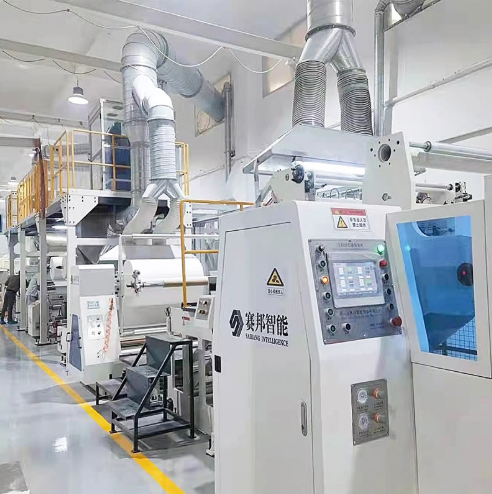
Our product fits naturally into this stage because it is built for continuous SAP sheet production used in absorbent core structures. In practical terms, that means the business is not only investing in a machine. It is investing in a more stable core foundation for the final diaper product.
Why Efficiency Matters More Than Many Buyers Expect
Many people ask whether diaper demand is strong enough to make the business profitable. In reality, demand alone is not enough. The real question is whether the line can produce efficiently without losing quality. A profitable diaper factory usually needs steady output, controlled waste, and enough flexibility to respond to different market needs.
That is why production efficiency matters so much. If one line runs slowly, switches specifications with difficulty, or requires constant manual correction, the operating cost rises quickly. Even if raw materials are sourced well, the margin can still disappear through waste, downtime, and unstable output. On the other hand, a line that runs with better control usually supports more predictable planning and cleaner cost management.
This is also where buyers start paying closer attention to core equipment instead of looking only at the final assembly line.
Why The Core-Making Stage Affects Profit
In diaper production, the absorbent core is not a small detail. It directly affects whether the diaper can deliver the performance customers expect. If the gram weight varies too much or the layer structure is inconsistent, the product becomes harder to position in any serious market. That is especially true in mid-range and higher-value segments, where buyers expect better absorption and better dryness.
A stable SAP sheet process helps support that goal. Our product direction is built around continuous metering, spreading, compounding, and winding of absorbent sheet materials. That matters because a cleaner and more stable core-making stage helps the factory reduce downstream trouble. Better core consistency usually means fewer product defects, more reliable finished diaper quality, and better confidence when supplying distributors, private label brands, and project buyers.
For factories that want to build a serious diaper business, that kind of process control often has more effect on profit than people expect at the start.
The Real Meaning Of Equipment Cost
One of the first questions buyers ask is about Diaper Making Machine price. That is understandable, but price alone rarely tells the full story. A lower machine price may look attractive at first, yet the real business result depends on what the equipment can actually deliver after installation. If the machine cannot keep spreading accuracy stable, if speed drops too much in real production, or if rewinding quality causes later feeding problems, the lower purchase cost may end up costing more over time.
This is why experienced buyers usually think in terms of total production value instead of only initial cost. They want to know whether the machine can run in a stable way, whether product quality remains consistent, and whether the supplier can support line matching and later service. In other words, they are not only buying a machine. They are buying production confidence.
That is where diaper making machine price becomes a business decision rather than a simple number. The better question is whether the equipment helps protect margin after production begins.
Why Market Positioning Changes The Profit Model
Not every diaper business makes money in the same way. Some factories focus on high-volume basic products. Others work on private label projects with more flexible specifications. Some target baby diapers, while others move into adult care, nursing pads, or related absorbent products. Each path changes the margin structure.
That is why buyers increasingly look for machinery that can support more than one fixed product plan. A business that can respond to different basis weights, core structures, and product requirements usually has more room to adapt. That flexibility becomes even more valuable when the market shifts or when one customer requires a different specification from another.
Our product supports that kind of thinking because it can work as a front-end core module connected to a diaper production line or run independently for SAP sheet production. For B-end buyers, that kind of flexibility matters. It supports line planning, multi-model production, and a wider range of product development options.
What Buyers Usually Worry About
For importers, converters, and factory investors, the usual concerns are very practical. They want to know whether the machine can maintain output over time, whether the SAP spread stays accurate, whether the winding remains stable, and whether the machine can adapt to raw material differences. They also worry about how long it takes to switch specifications and whether the supplier can support customization if the line requirement is not standard.
These are not minor issues. In diaper production, small instability in the core layer can affect the full finished product. If the absorbent sheet is not stable, later steps become harder to control. That is why many buyers prefer working with a supplier that can discuss the process in detail instead of only sending a standard offer sheet.
OEM and ODM support also matter here. In real projects, some buyers need width changes, some need different layer structures, and some need control logic adjusted around an existing line. A supplier that can support those practical requests is usually more valuable than one that only sells a fixed machine model.
Why Long-Term Profit Depends On Stability
A diaper business becomes profitable when production can stay stable long enough to build repeat business. The first order is important, but the real value usually comes from reorders, longer contracts, and product lines that can hold their quality over time. If the line cannot support that consistency, the business ends up fighting preventable problems instead of growing.
That is why machine stability matters so much. A better front-end process helps support more predictable core quality. More predictable core quality helps the factory protect product performance. Better product performance helps support customer trust. In this industry, those steps are closely connected.
So yes, diaper business can be profitable, but usually for factories that take equipment choice seriously and think beyond short-term output.
Conclusion
The diaper business can be profitable when the factory has the right production setup, the right product positioning, and the ability to keep quality stable at scale. Demand alone does not create margin. Profit usually comes from controlling waste, improving consistency, and building a product that customers will reorder with confidence.
That is why equipment selection plays such a large role, especially at the absorbent core stage. When buyers compare diaper making machine price, it makes more sense to look at long-term production value, not just the first quotation. If you are planning a diaper project, reviewing absorbent core solutions, or looking for OEM and ODM support for your production line, feel free to contact us. We can help you review your application, discuss a suitable setup, and support your project with practical guidance.
Previous: